Ultimate Guide to Marketing Assisted Living Facilities: Proven Strategies to Maximize Occupancy
Marketing for assisted living and senior care comes with unique challenges. You can’t just slapdash generic healthcare marketing tactics onto your messaging and be done. There are real problems you’ll face when you start down this road:
- Your reach is limited by platform rules
Google and Facebook place strict restrictions on how senior housing can be advertised. You can’t directly target seniors. Depending on the ad policy, you might be limited in ways to promote your service. - You’re competing with large corporate chains
No level playing field here. National operators and large directories have years of brand recognition, dominate visibility, have massive content libraries in place, and carry heavy domain authority. Search engines like Google and Bing will naturally prioritize the web content of these established players. If you’re running independently or even regionally, you’ll struggle to get customer attention. - Decision making takes time, and memory is weak
Adult children usually tour five to seven communities and take months to make their choice. If you don’t stay in touch (without being pushy) during this deliberation period, even the most interested families will eventually lose interest and move on. - The decision is deeply emotional and requires real connection
People are essentially giving over care of their closest family when they choose an assisted living facility. Sometimes, this decision is made during a stressful time (such as the death of one parent). Your marketing has to go the extra mile (every time) to ensure safety, comfort and dignity. You have to be transparent, credible and trustworthy…a difficult feat in the age of “Is that an AI video?”
How do you get this done? It’s a lot of work, but this piece will lay out proven strategies for advertising senior living communities. This is how you generate consistent inquiries, turn tours into move-ins, and maintain strong occupancy.
1. Identify Your Competitive Advantage
Families looking for assisted living are never looking at just one option. They’re making pros and cons lists when comparing communities. They’re touring different facilities, pouring over reviews and trying to answer a really difficult question,
“Will my parents be okay living here?
So, don’t try to be the right fit for everyone. That’s unrealistic. Instead, aim to be the best option for a niche you’re best suited to serve.
Figure out your competitive advantage before starting on marketing. Your web copy, ads and follow-ups must set your community apart.
Location and Daily Convenience
Proximity goes a long way in clinching the deal. If you’re located close to where the adult children live, or near major hospitals or a good neighborhood, you’ll gain immediate trust. Talk up the ease of visits, familiar environments, shorter drives and more peace of mind.
Depth of Care
Tell families not just what services you offer but how well you offer them. Highlight memory care programs, dementia-specific training, strong staff-to-resident ratios, and geriatric certifications to indicate high competence and preparedness. Do extra to reassure families that their loved one’s needs are met from the get-go.
Daily Life That Feels Meaningful
Show families how their parents will be engaged, respected, and actively living life. Highlight pet therapy, art programs, outings, transportation support, or chef-prepared meals. Underline the experiences that make elderly folks’ day-to-day life feel fuller.
Clear Pricing and Real Financial Flexibility
Show families how their parents will be engaged, respected, and actively living life. Highlight pet therapy, art programs, outings, transportation support, or chef-prepared meals. Underline the experiences that make elderly folks’ day-to-day life feel fuller.
Reputation and Family Trust
Gather honest reviews and testimonials. Actively announce that you welcome family involvement. Communicate openly and demonstrate social proof that you convert tours into move-ins.
Tour Experience and Availability
Gather honest reviews and testimonials. Actively announce that you welcome family involvement. Communicate openly and demonstrate social proof that you convert tours into move-ins.
Call out those details. When someone needs help now, responsiveness can move the needle on the deal faster than anything else.
2. Technical Foundation: Building a High-Performance Website
Patient Procure Free Audit Offer
In this 30 minute call, I will personally analyze your entire digital presence, uncovering exactly what is working, what is holding you back, and where the biggest opportunities lie.
Then, I will walk you through the proven steps you need to take to get real results step by step.
Book a CallYou can’t show up for families on the search if you don’t rank on search engines, especially Google. Your website must be technically pristine so that Google favors it.
Quick Positives here:
- Sites that load quickly
- Sites that work well on mobile
- Sites built for easy navigation
Quick Negatives here:
- Broken links
- Missing pages
- Web pages that Google cannot properly crawl
Technical SEO is complex, but you don’t need to know everything. These foundational elements will drive plenty of visibility and conversion.
Site Structure and Navigation
Two rules lie at the core of a strong website:
- Create pages that your audience is actively looking for.
- Make every important page available within three clicks from the homepage
Be clear on what families are looking for:
Care details, pricing clarity, and how to schedule a tour. If they don't find this within seconds, they will most likely leave.
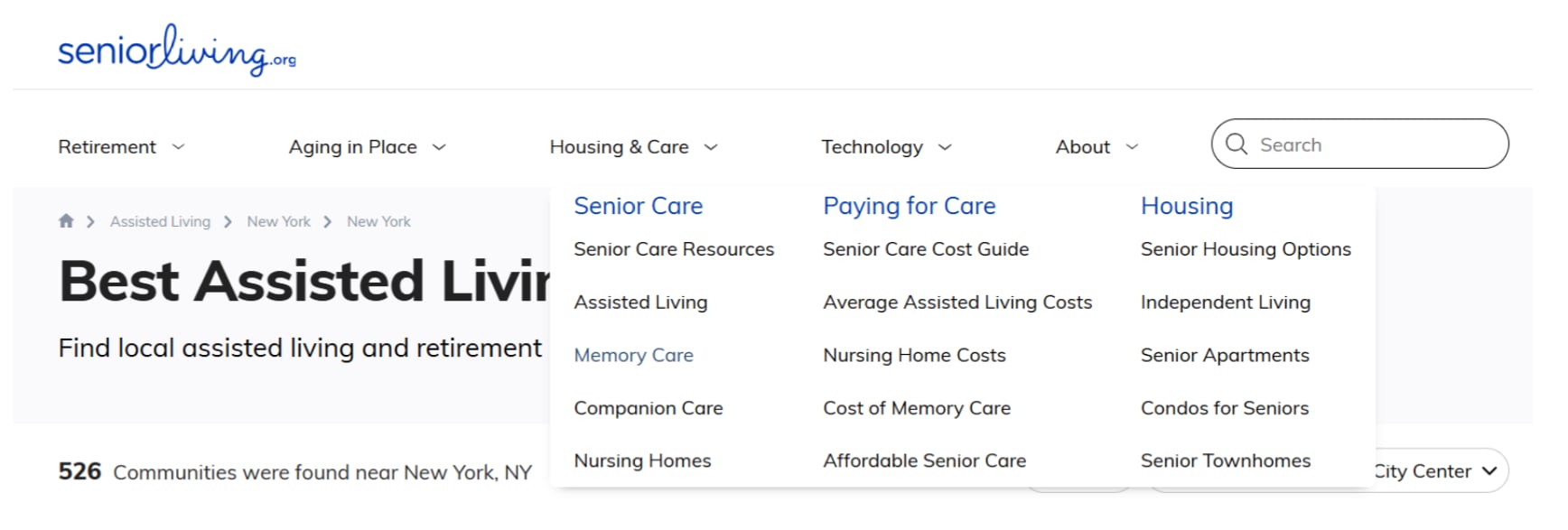
This navigation hierarchy generally works well for websites advertising assisted living communities. It follows how families would think, and how they would search.
- Home
- Care & Services
- Amenities & Lifestyle
- Pricing and Payment Options
- Tour Our Community
- Resources
- About Us
Don't forget your footer. At minimum, include:
- Privacy Policy
- Terms of Service
- Sitemap
- Accessibility Statement
- Non-Discrimination Policy
These pages are a bare minimum. Build the content to signal professionalism, compliance, and credibility. Families are already stressed. Keep their frustration low and you’ll likely get increased tour requests.
Mobile Optimization
More than 60% of all online searches in the US happen via mobile devices. People are looking for assisted living facilities on the go, between meetings, and late at night on a tablet or phone.
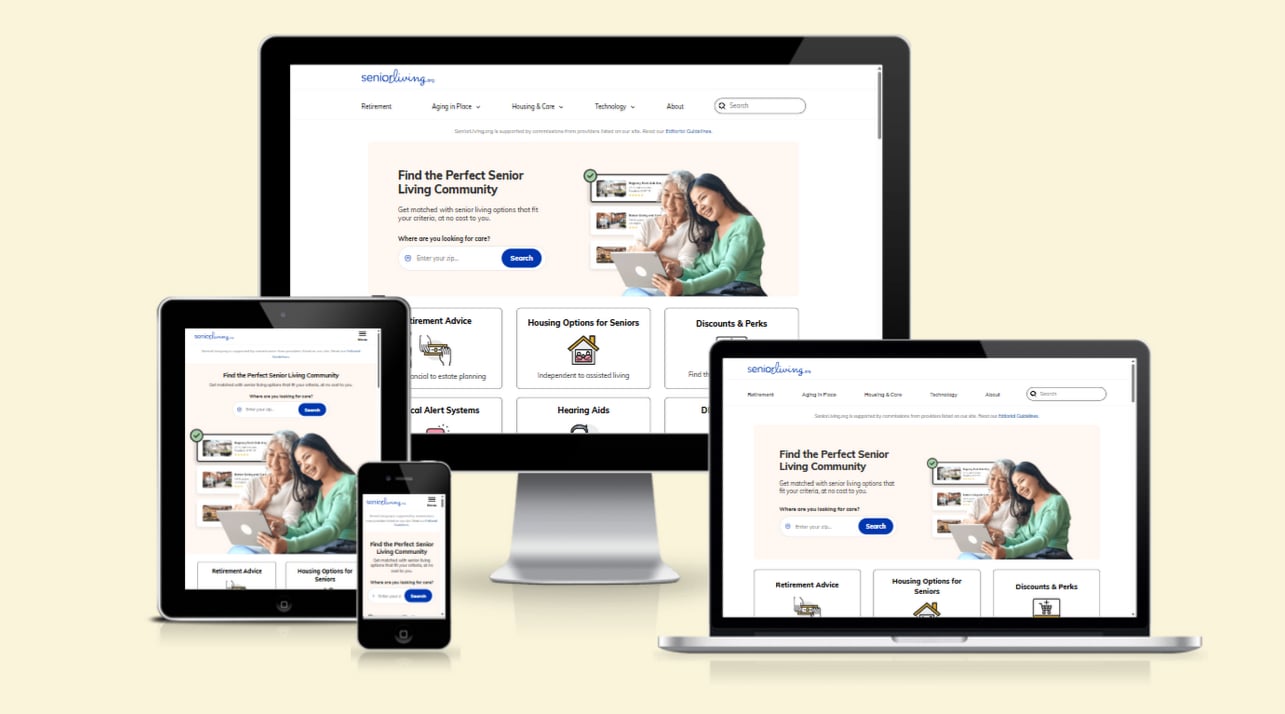
Your website needs to offer a solid mobile experience. Not just responsiveness but also practical usability and navigability so users can find everything they need with a couple of easy scrolls.
Pay attention to:
- Click-to-call buttons: Should be easy to spot and comfortable to tap. No zooming should be required.
- Tour request forms: Should load within seconds. Should be easy to fill and submit on smaller screens. No hidden fields or awkward layouts.
- Photo galleries: Should display beautifully but not eat up data or load slowly on slower connections.
- Readability: Should not require pinching, zooming, or awkward swiping to read your content.
On smaller screens, every extra tap runs the risk of losing a potential resident's attention an future patronage.
Page Load Speed
Your prospective clients are running on thin patience. They have full time jobs, kids, mortgages and are jumping between tabs and websites between meetings and daycare drives, trying to absorb too much information within minutes.
If your site is slow or unresponsive on top of that, expect them to abandon it within seconds.
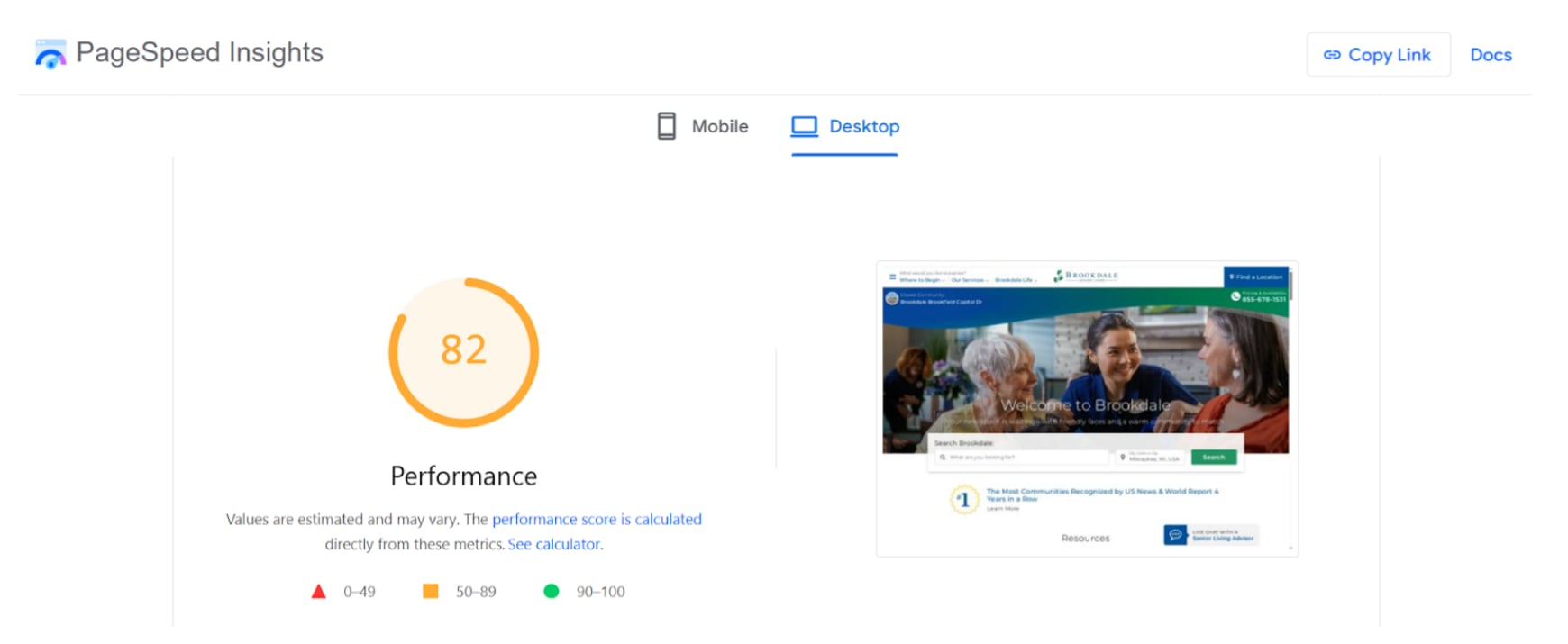
Start by checking your site speed on Google PageSpeed Insights, free and easy to use. If your site consistently scores below 70, start running fixes. Compress large images, implement lazy loading, improve server response time, and clean up unnecessary scripts. You can hire someone affordably to do this on Upwork or Fiverr.
For a closer look at the site’s backend, run technical audits via Screaming Frog or Ahrefs’ Site Audit. They will surface issues like broken links, duplicate pages, or crawl errors that limit visibility.
That said, don’t bother too much with minor technical gaps if your website loads reasonably fast, works on mobile, and most important pages are quickly accessible. Focus on creating clear structure and fast, frustration-free experiences. That earns trust.
3. Content Strategy: Ranking for High-Intent Local Searches
Families won’t discover any assisted living communities by randomly browsing. They’re looking with high intent, heavy emotion, and specific questions.
Bottom line, your site needs to show up when someone searches “best assisted living in [your city]” or asks an AI tool for local recommendations.
Otherwise, you’re invisible, no matter what else you rank for.
Search engines and AI platforms reward depth, relevance, and proven expertise.
You cannot compete with national directories and operators from the get-go. Instead, focus on a thoughtful content strategy addressing local intent.
Keyword Research: What Families Actually Search For
These are two categories of phrases families use when comparing assisted living communities:
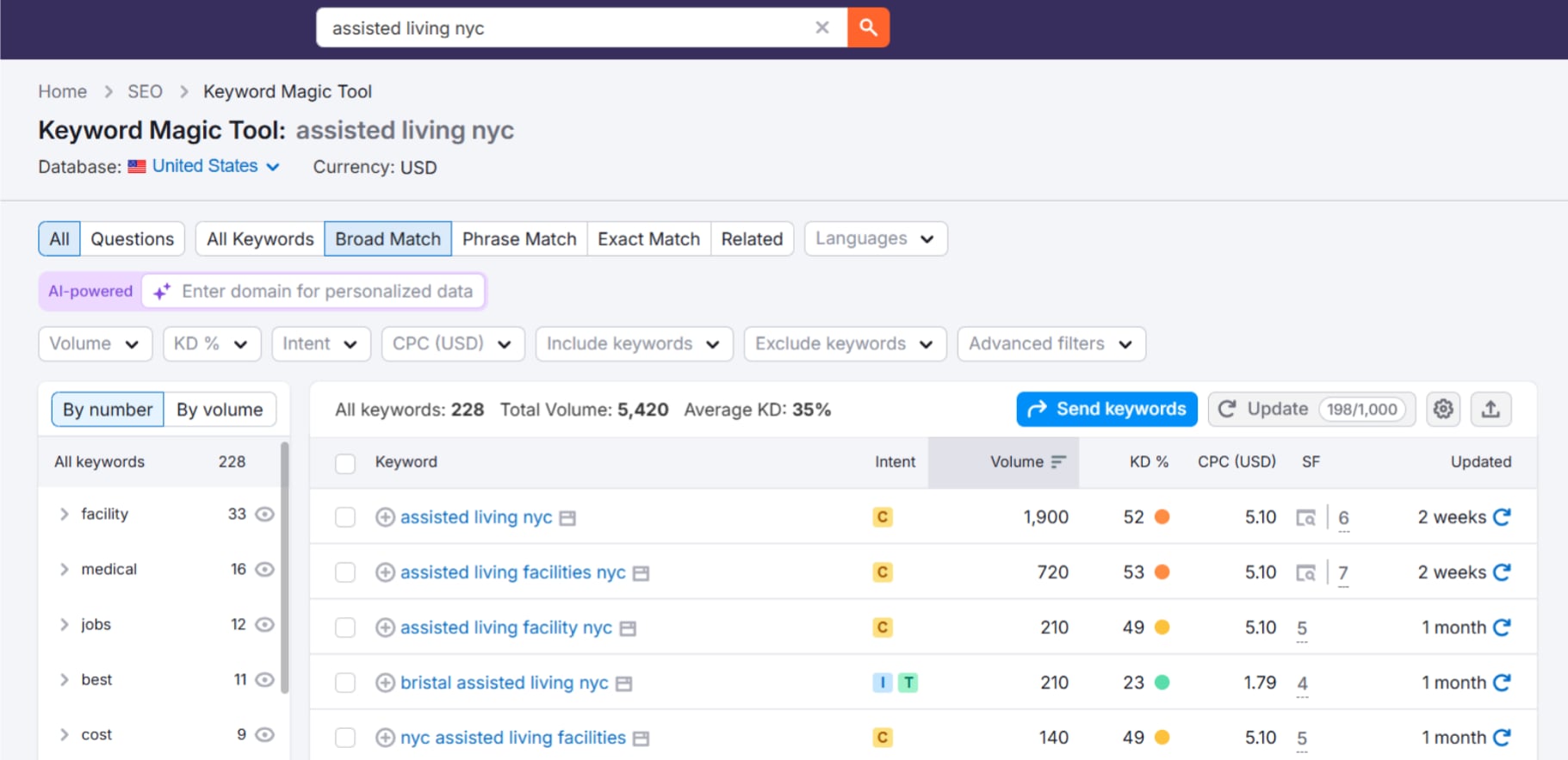
Local, high-intent searches (closest to conversion):
- Assisted living in [city name]
- Memory care [city name]
- Senior living near [neighborhood]
- Affordable assisted living [city]
- [City] assisted living costs
Families querying these phrases are actively looking at different communities. Build dedicated location pages for each phrase. Do the following to optimise them:
- Use the primary keyword in the page title, H1, and naturally throughout the content.
- Keep URLs clean and descriptive (for example: yoursite.com/assisted-living-atlanta)
- Underline local context like hospitals, transportation options, and community partnerships in the area.
- Showcase your real staff members, photos of the actual community, and services specific to that area.
Information searches (early research stage):
- When is it time for assisted living?
- Assisted living vs nursing home
- How to pay for assisted living
- Dementia care at home vs facility
- Moving a parent to assisted living checklist
- Assisted living costs by state
People typing these phrases are usually months away from scheduling a tour. Answer these questions and they will see you as a trusted option before beginning a sales conversation.
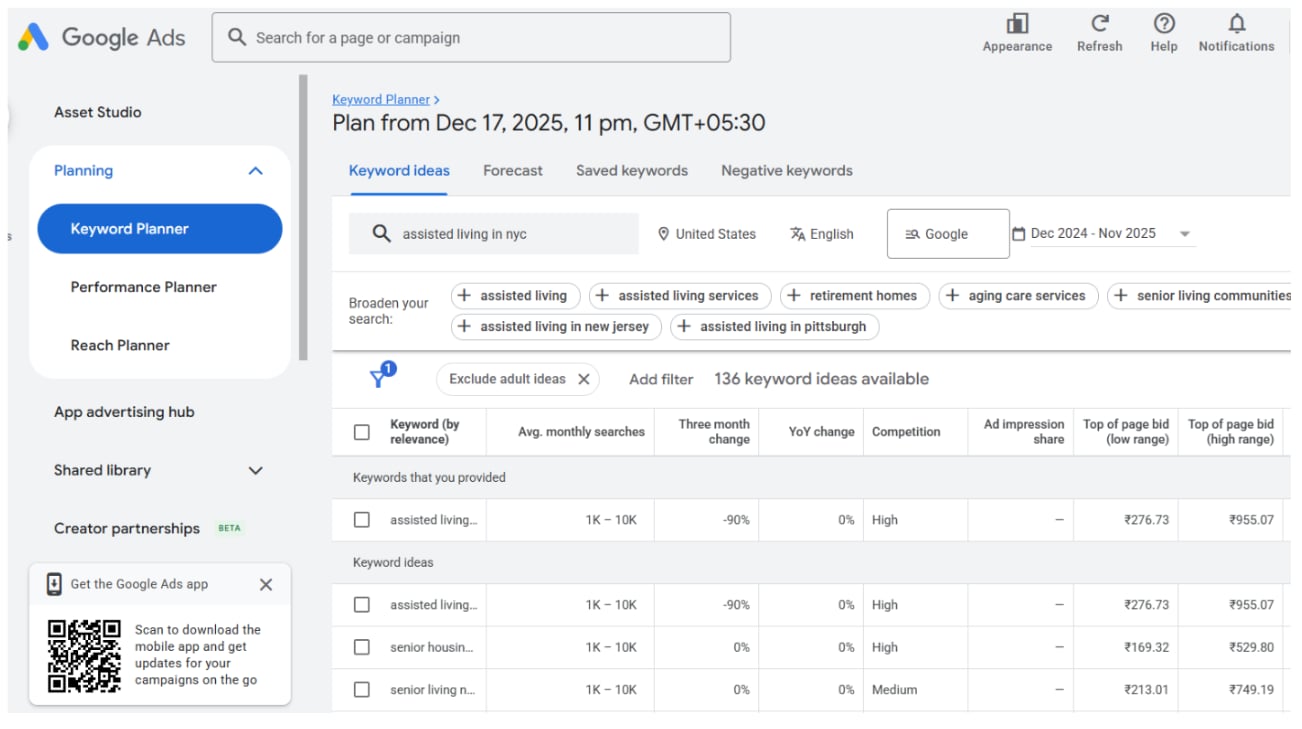
Use tools like Ahrefs, SEMrush, or Google Keyword Planner to find keywords with meaningful search volume and realistic competition. Publish the right content in line with how families actually search, think, and decide.
Creating Content That Ranks
After finding the right keywords, allocate a dedicated page to each topic. Search engines love content depth and real-world expertise, especially for healthcare.
Generic, AI-generated content will underperform as it regurgitates what exists without any real insight. Use AI as a planning tool, and your real experience to make content a true differentiator.
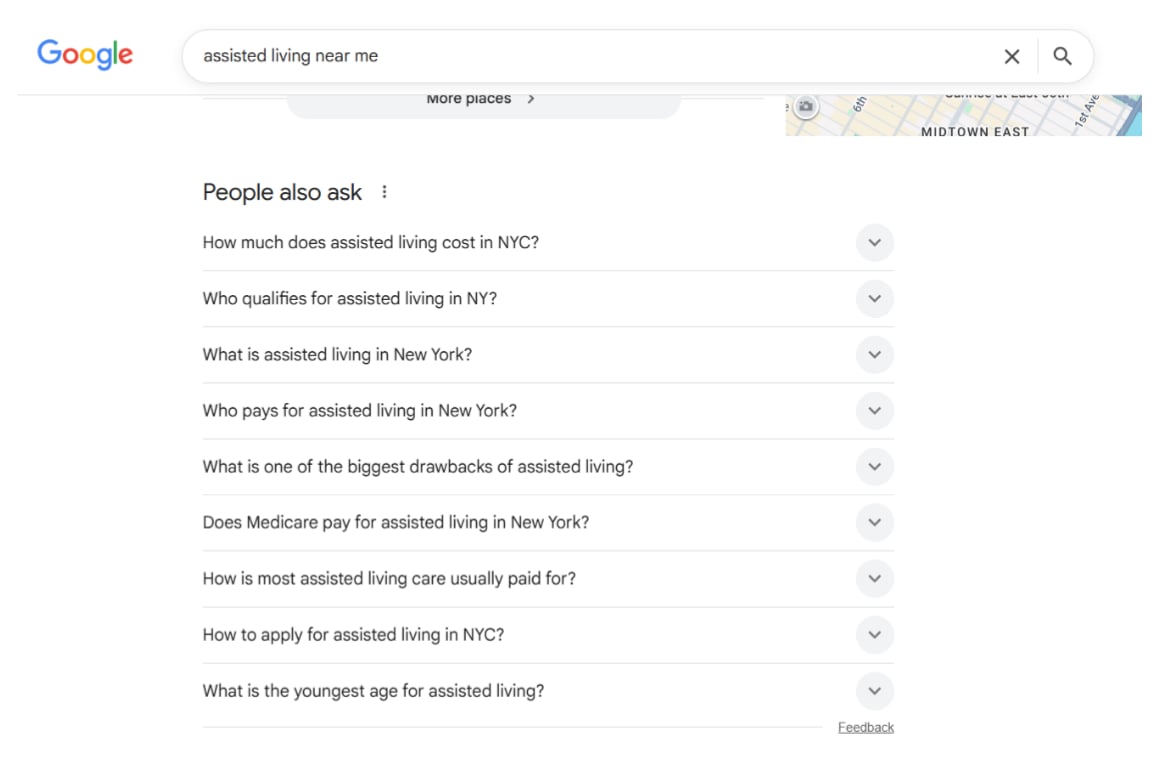
AI can:
- Build researched outlines with tools like Frase or Clearscope.
- Identify common family questions using tools like AnswerThePublic and Google’s “People Also Ask”.
Ground the content in your staff’s experience as well as industry intelligence. This part is crucial! Ask directors for their input. Give examples from real family conversations. Google favors your unique experience.
Yes, check SEO boxes. But also show understanding, credibility, and lived experience. You must appeal to both algorithms and real humans.
Content quality checklist:
- Use your main keyword naturally in the title and opening paragraph.
- Pull language from real tours, phone calls, and emails.
- Quotes from your executive director or care coordinator add credibility.
- Link naturally to your tour request and pricing pages.
- Get the content reviewed by a licensed administrator or healthcare professional. Mention it prominently.
Multi-Channel Content Distribution
Blog content is non-negotiable, but not enough to get you real leads and tour bookings. Your clients will look for assisted living solutions across different platforms, and you need to show up wherever they are.
Your content distribution strategy should ideally cover:
- YouTube: Virtual tours, “day in the life” videos, and staff interviews that help families see what they’ll be getting.
- Facebook: Community events, resident stories, and educational content shared within family networks.
- LinkedIn: Executive-level insights that reach adult children in their 40s–60s, the active decision makers.
- Local partnerships: Guest content on senior resource sites, hospital referral pages, and aging-focused publications.
Ahrefs even found that brands with broader online mentions are more likely to appear in Google’s AI Overviews (the AI-generated answers shown above search results). Consistent presence reinforces credibility and builds trust.
4. Dominating Local Search Results
When families type in phrases like “assisted living near me” or “memory care in [city],” Google highlights a small map at the top of the page with three nearby communities. This section is the Local Pack. Usually, it’s the first thing families see and the first place they click when they start research.
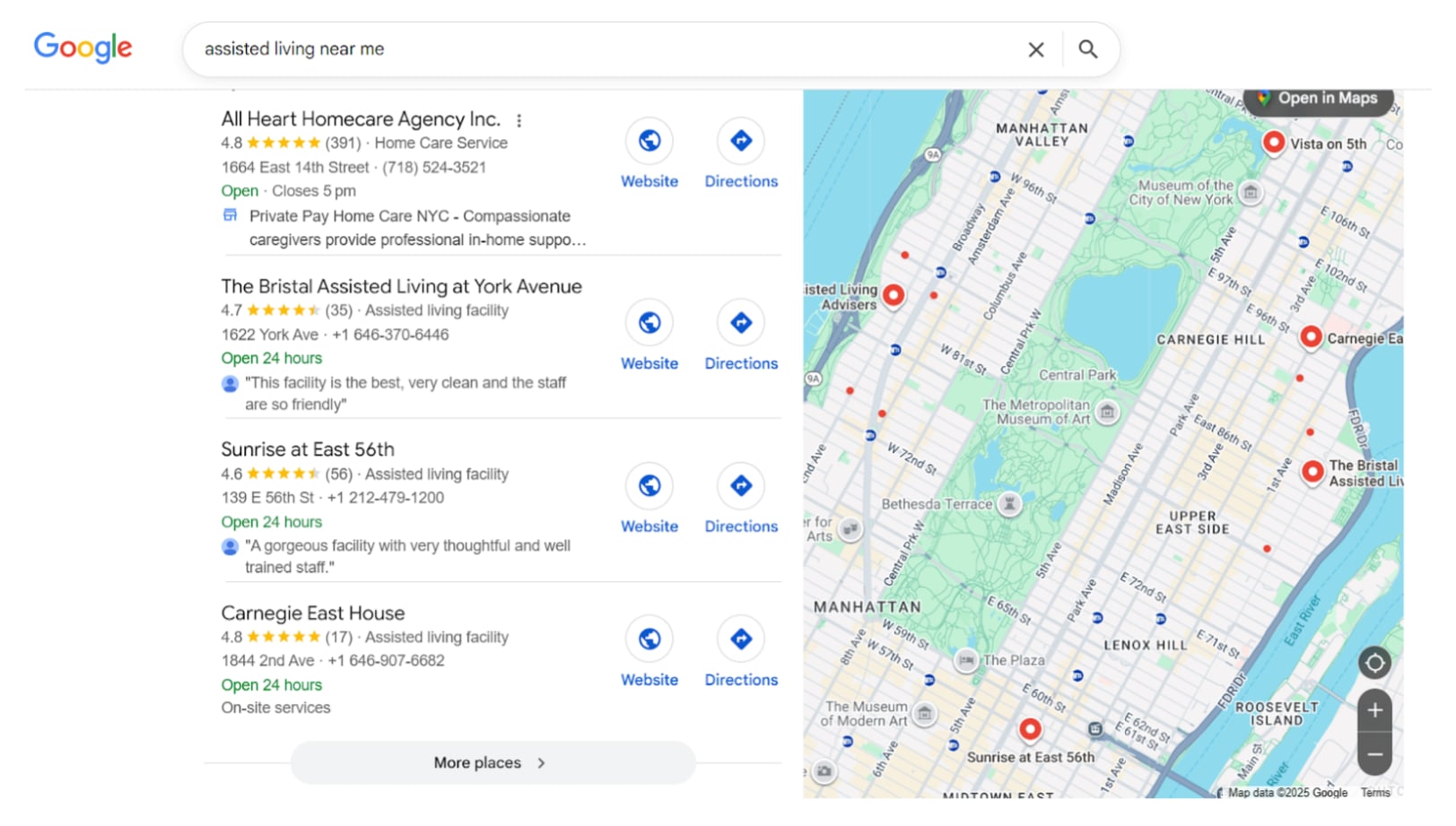
Businesses in the Google Local 3-Pack receive 93% more actions (calls, website clicks, driving directions) than competitors. If your community doesn’t show up here, many of your prospective clients will never know you exist.
Optimizing Your Google Business Profile
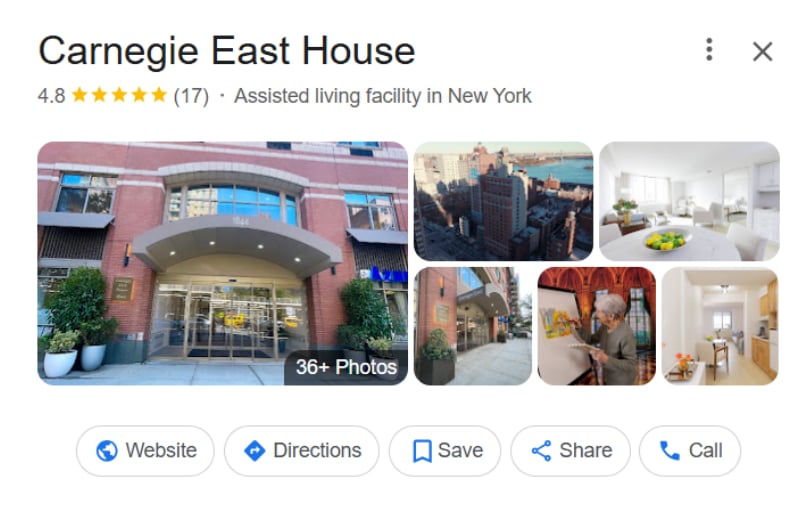
For most people, a Google listing is their first real interaction with any business, including your community. That’s where they are scanning photos, reading reviews, and checking basic details to see if they like you enough to shortlist.
Naturally, a fully optimized Google Business Profile is the foundation of your digital marketing push. This is everything you need for an active, transparent, and engaging profile.
- NAP
- Complete every section - Accurately mention your business hours (including holidays), phone number, website, services, and accessibility attributes. Update every change.
- Include obviously important details - Things like accessibility, whether you accept Medicaid, etc. Families actively look for this information when shortlisting assisted living options.
- Show off real visuals - Photos help families imagine daily life, even if they can’t visit in a week. Upload at least 20–30 high-quality pictures of exterior views, common areas, resident rooms, dining spaces, activity areas, and staff. Refresh them every few months with seasonal events or new amenities to keep your profile current.
- Write a clear, reassuring business description - You get 750 characters to explain who you are and why you’re the best choice. Talk about what makes your care approach different, your values, and your community’s strengths. Mention your primary keywords naturally somewhere in the mix.
- Publish weekly Google Posts - Weekly posts make your profile and your community engaged. Share posts about coming events, availability, staff introductions/experience, family testimonials, and information around elderly care. Posts signal relevance and activity to Google’s local algorithm.
A great Google Business Profile delivers a trusted first impression to families looking for reassurance, clarity, and care.
Strategic Review Generation
Families care about reviews. You, as a business, have every reason to hype your facilities. Other families you have served do not.
Reviews influence where you appear in local search results and also whether a family feels confident booking a tour. They matter for local rankings (~10% of local SEO factors) and can lift conversions 15-20% and revenue up to 18%.
Build review requests into natural touchpoints
For instance, a simple, automated email sent 15-30 days after someone becomes a resident. Include direct links to your Google, Facebook, and senior living directory profiles so families know where to find you if they are interested.
Ask in person when the moment is right
Consider the family’s emotions when you’re asking them to choose you. After a family dinner, holiday event, or a positive care-plan conversation, a personal request carries far more weight. Families are often willing to make the right choice after spending time with their aged relatives.
Use QR codes
Place review QR codes in high-traffic areas (the front desk or lobby) with a clear request or prompt: “Share your experience to help other families.” If something is easier, more people will do it.
Help families write
Many people aren’t sure about how to review assisted living communities. Help them with prompts:
- What made you choose our community?
- How has our staff supported your family?
- What would you tell others who are looking for assisted living?
Stay compliant and ethical
Never offer incentives, discounts, or gifts in exchange for reviews. This violates Google policies and FTC guidelines. You will damage users’ and Google’s trust.
Respond to every review
Thank families for positive feedback and address negative reviews calmly and professionally. Response quality and timeliness impacts rankings and perception. It also shows that you listen.
Building Citation Consistency
Families researching assisted living options are often cross-checking information across multiple websites. Google does the same.
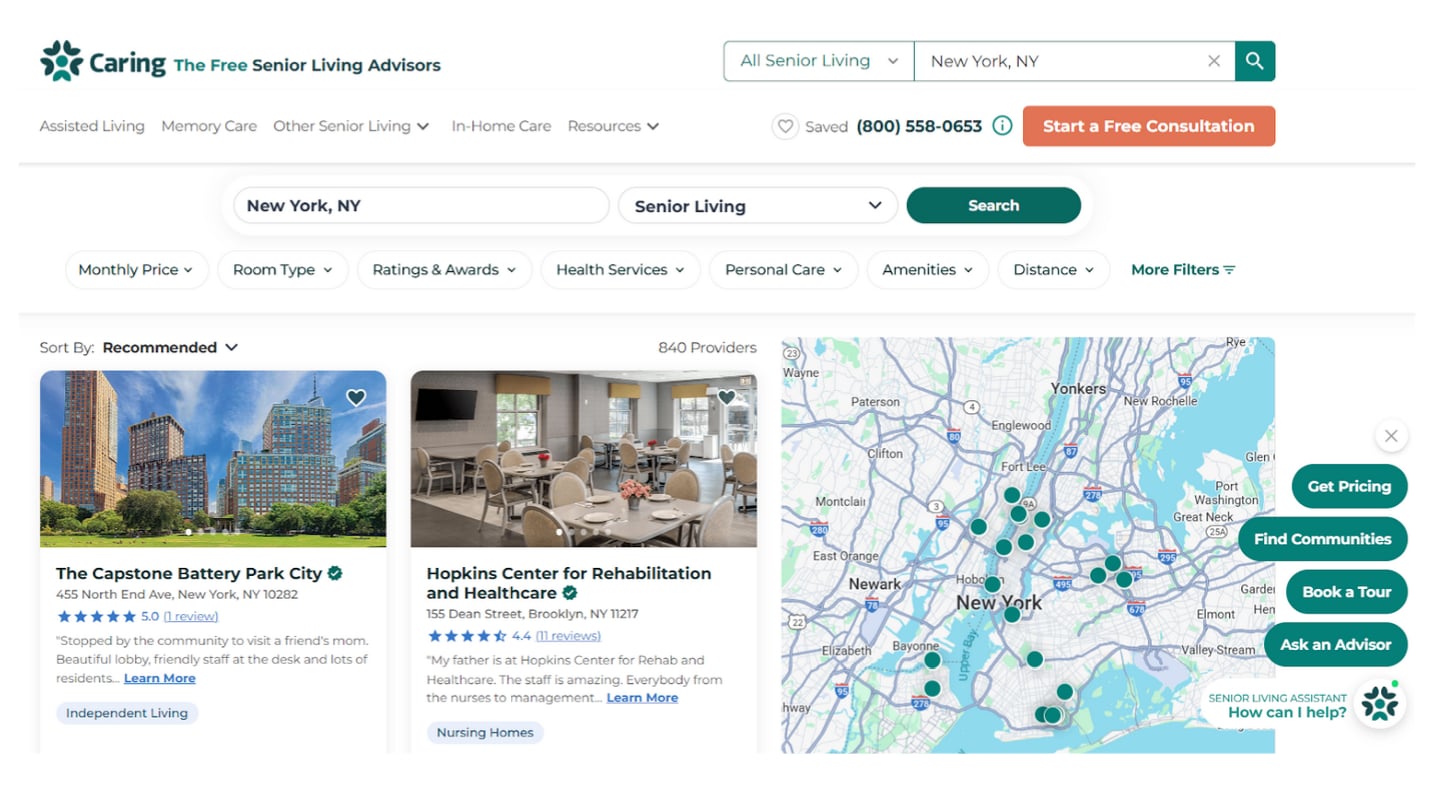
Citations are online mentions of your facility’s name, address, and phone number (NAP) across senior living directories, local listings, and healthcare platforms. If this information is consistent across 30–50 reputable sites, it shows Google that your community is legitimate and established.
A few important directories in senior living:
Don’t underestimate even small inconsistencies like an old phone number or a missing suite number. They will undermine trust and local rankings. Use tools like BrightLocal, LastMile, Synup or Yext to audit existing listings, find errors, and update information across hundreds of directories at once.
5. Capturing and Converting Leads Over Time
Most families will not book a tour the first time they visit your website. They gather information, compare facilities, and put things off until they have to make the difficult decision. That decision cycle often stretches 180 days.
If you don’t capture user contact information and stay in touch during that window, many families will disappear. They might have been interested, but another community kept the conversation going.
Effective senior care marketing is about earning trust over time, and email is a reliable way to do that.
Creating High-Value Lead Magnets
Cut the fluff. Offer something that genuinely helps them think clearly, not another sales pitch.
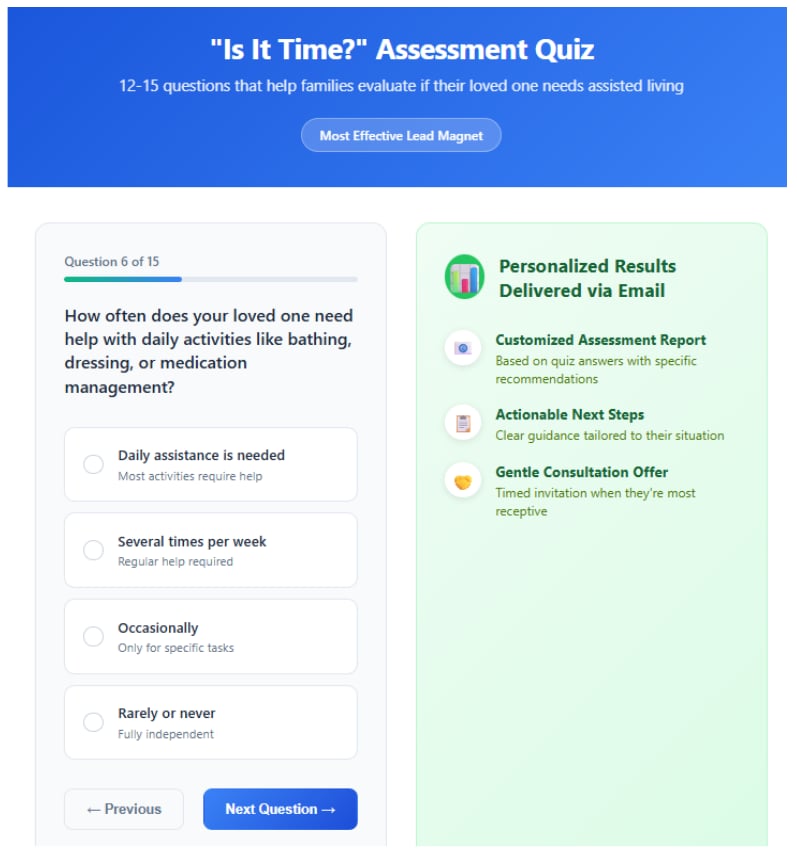
An "Is It Time" Assessment Quiz
A 12–15 question quiz for families to decide whether their loved one may need assisted living. Results are sent via email, along with recommended next steps and an optional consultation.
Comprehensive pricing guide
Create a piece on "The Complete Guide to Paying for Assisted Living in [Your State]". In it, cover Medicare/Medicaid, long-term care insurance, veterans benefits, and alternative financing options.
Moving transition checklist
Offer a downloadable PDF with timeline, tips on room setup, what to pack, and how to help seniors adjust emotionally.
Local senior resource directory
Build a curated list of geriatric doctors, elder law attorneys, home care agencies, and support groups in your area.
Promote these assets within exit-intent popups, dedicated landing pages, email, and social media ads targeting adult children aged 45-65.
Building Automated Nurture Sequences
Once you get a family’s email, resist the temptation to sell, sell, sell. Your job is to be helpful while they make that difficult decision.
When in doubt, use a 6–8 week email sequence to gently educate, build trust, and be remembered without being pushy.
A practical sequence you might want to consider:
- Email 1 (immediate): Deliver the resource they requested and briefly explain your care philosophy.
- A few days later: Assuage common fears about moving to assisted living and what families can realistically expect.
- Week one: Share a real resident story or a short family testimonial video.
- Week two: Lay out your care assessment process. Full transparency so there are no surprises.
- Week three: Give them financial options and invite them to schedule a tour. Mention if availability is limited.
- Around one month: Offer a clear reason to take action. Eg., priority tour scheduling or a waived community fee.
Be mindful to give something useful in each email. Sales pitches will turn off families and you’ll come across as mercenary.
Use honest, helpful emails to naturally guide families toward the next step. Ask the right questions, invite them to speak with your admissions director, help them book a tour on priority.
Keep calls-to-action simple and relatable: Schedule a Personal Tour, Talk With Our Admissions Team, or Estimate Monthly Costs.
6. Building Authority Through Strategic Partnerships
You can talk yourself up all you want, but other credible people and organizations have to say it too.
Search engines and LLMs like ChatGPT monitor which brands are mentioned and linked to by trusted local and national sources. Be one of those senior living communities, and you’ll go from “one more option” into a credible choice families want to know more about.
The formula isn’t complicated here: show up locally and be useful.
Local Community Engagement
Get involved in your communities in local engagements. Backlinks and visibility will follow.
- Event sponsorships - Support Alzheimer’s walks, senior health fairs, caregiver groups, or local fundraisers. You’ll be noticed by families while doing real good. Just remember to include your logo and website on event pages, press releases, and promotional materials so people and search engines know who you are.
- Educational workshops - Host free sessions at libraries, senior centers, or community colleges on related topics: Planning for Long-Term Care, Understanding Dementia, or Medicare vs. Medicaid. Position your team as educators, rather than salespeople. Event promoters will typically link back to your site, expanding your audience well beyond attendees and most importantly building authority.
- Scholarship programs - Set aside a few annual $500–$1,000 scholarships for nursing or gerontology students at nearby universities. Step up to support innovation in elderly care, and earn links from .edu domains (far greater authority and long-term value).
- Hospital and medical partnerships - Set up and maintain relationships with discharge planners, geriatric care managers, and physician practices. They often maintain online resource pages and can refer families to trusted assisted living partners.
Earning Media Mentions and PR Coverage
If you can get respected publications to mention your community, it improves how people and algorithms perceive you. Show up as a calm, credible voice in a space where families are looking for reliable guidance.
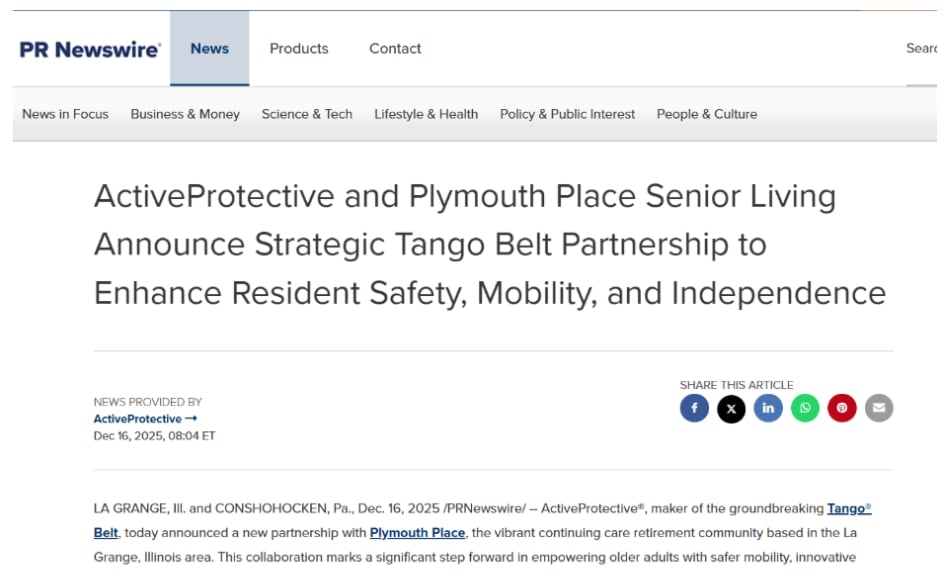
A feature in a national outlet like AARP, Forbes, or a well-read regional paper boosts visibility and also reassures families that you understand the broader realities of senior care.
- Create information journalists actually need
Reporters actively look for credible data and informed perspectives. Make an effort to show up on surveys of local caregivers. Drop insights on aging trends in your region. Journalists get solid data to work with, and you are positioned as a source, not a promoter. - Build relationships before you need coverage
Follow local health and aging reporters on LinkedIn or Twitter. Comment thoughtfully on their posts. Offer yourself as a resource when senior living questions come up. - Respond when journalists ask for help
Look around on HARO or Quoted for feature requests from reporters looking for senior living expertise. Put thought into a short, well-reasoned response that can build long-term credibility. - Speak up
When issues like staffing shortages, regulatory changes, or public health concerns come up, families pay extra attention. Offer your executive director’s perspective to local media. Show real leadership and steadiness during uncertainty. - Get on the right podcasts
Find industry and caregiver podcasts where your administrator or care director can talk honestly about challenges, innovations, or lessons learned. Again, families are listening closely.
Referral Partner Link Building
Your biggest visibility gains will likely come from relationships you already have.
Particularly, pay attention to professionals who serve the same families you do. If they trust you enough to refer you, they will probably link to you as well. Those links carry weight because they come from real, relevant organizations.
The most effective referral partners would be:
- Elder law attorneys
- Financial advisors focused on retirement planning
- Home healthcare agencies
- Geriatric care managers
- Estate sale companies
- Senior moving services
Reach out for a simple, respectful exchange: you put them in a local resource guide on your site, and they list your community as a trusted option on theirs. Both sides benefit, as do the families you both serve.
Pro tip: Create a dedicated Helpful Resources page. List these partners with short descriptions and links.
7. Accelerating Results with Paid Advertising
Paid advertising can work only if the foundation is solid.
Sending paid traffic to a website without clear messaging, strong reviews, or real credibility just wastes your money. Families may click, but they won’t convert if they aren’t convinced by what you’re putting out there.
Your organic efforts build visibility and teach you what matters. Over time, they surface which keywords lead to real inquiries, which messages draw in families, and what concerns lead to scheduled tours.
With the right foundation, Google Ads and Facebook Ads become real amplifiers of your messages. They can help fill near-term vacancies and stabilize occupancy without blasting through your budget.
Google Ads: Capturing High-Intent Searchers
With Google Ads, you can show up exactly when a family is actively looking for help. They are searching with intent, often under pressure, and looking for someone to actually talk to.
Naturally, search ads should be focused on the terms this audience actually uses, such as:
Location-based searches (highest intent):
- Assisted living in [city name]
- Memory care near me
- [City] senior living communities
- Affordable assisted living [city]
Service-specific searches:
- Memory care for dementia [city]
- Respite care [city]
- Independent living [city]
Cost-related searches:
- Assisted living cost [city]
- How much is assisted living in [state]
- Medicaid assisted living [city]
Brand protection (often overlooked but critical):
- [Your Facility Name]
- [Your Facility Name] reviews
- [Your Facility Name] cost
Yes, you should bid on your own brand. Competitors frequently target other facilities’ names to poach your already interested audience. Run brand ads so that you show up first.
Google Ads does not and cannot replace organic marketing. It can complement it by capturing demand just when families are ready to act.
Match Types and Negative Keywords
Many searches are actually not worth your money. You can control when your Google Ads appear, so that you can get steady inquiries without a blown budget.
Google Ads offers three match types:
- Exact Match: Shows your ad only when someone searches almost exactly for your keyword. Most efficient and usually gets you the best leads.
- Phrase Match: Shows your ad when the keyword phrase is included in a longer search. Balances reach with relevance.
- Broad Match: Casts a wide net for more exposure, but can end up attracting the wrong traffic if used excessively and not strategically.
For assisted living, start with Exact and Phrase Match. You save money and get only relevant people who want and need your services.
Don’t forget negative keywords. They prevent your ads from showing up in searches that might look relevant but won’t convert. For example:
- “Jobs” and “Careers” (job seekers, not families)
- “Free” (researchers, not paying residents)
- “Nursing home” (if you don’t offer skilled nursing)
- “Cheap” (often signals poor-fit leads)
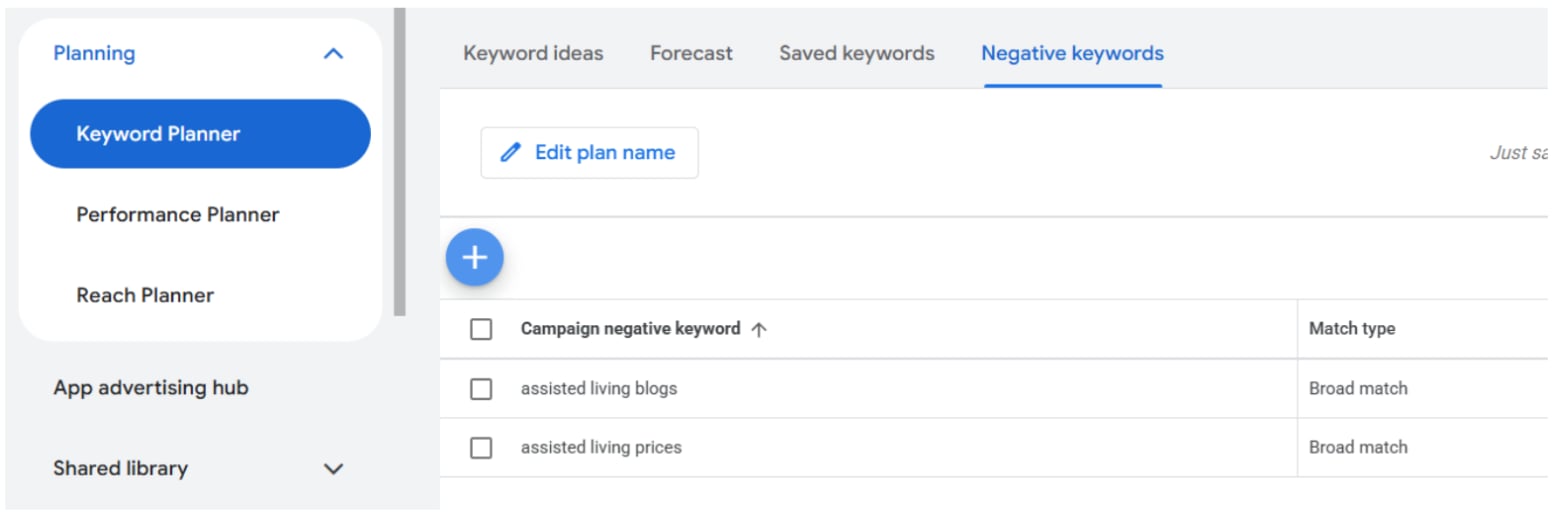
Match types and negative keywords are key to protecting your budget while also reaching families genuinely looking for care, not just information.
Geotargeting and Demographic Settings
Families rarely relocate loved ones far from their own homes. Proximity enables frequent visits and family involvement.
Set your campaign radius to 15-25 miles around your facility. Expand only if you're in a rural area with limited competition or offer specialized care drawing from wider geographic areas.
Layer demographic targeting for adult children (ages 40-70) who are typically the decision-makers, not the seniors themselves.
Compliant Ad Copy for Senior Housing
Your ad copy messaging has to meet strict platform policies designed to protect vulnerable populations.
Prohibited messaging:
- Age targeting language ("Perfect for seniors 75+")
- Health condition claims ("Cures Alzheimer's anxiety")
- Urgency tactics that prey on crisis ("Don't wait, beds filling fast!")
- Discriminatory language
Compliant messaging:
- "Compassionate Memory Care in [City]—Schedule Your Personal Tour"
- "Assisted Living with Restaurant-Style Dining & Activities"
- "Family-Owned Community Serving [City] Since 2005"
- "Transparent All-Inclusive Pricing—No Hidden Fees"
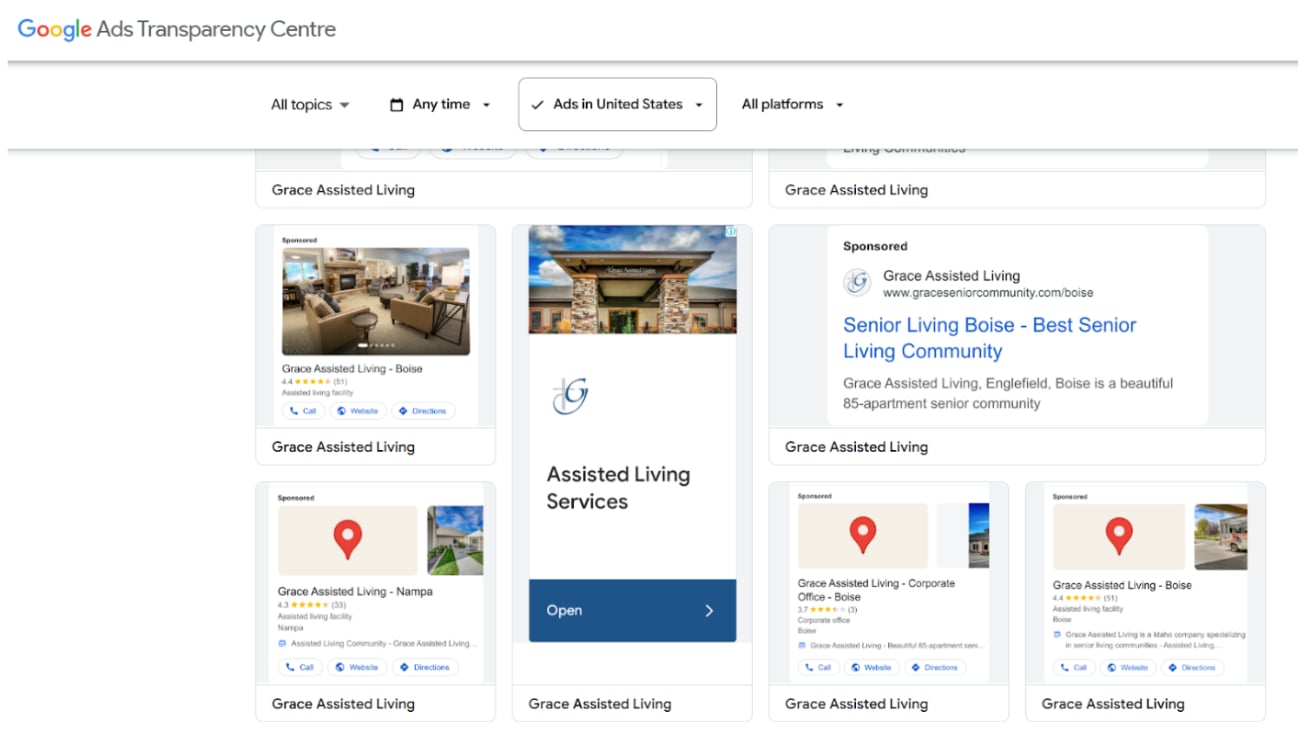
Pro Tip: Use Google Ads Transparency Center to research competitors' active campaigns and identify messaging that passes platform approval while also pushing real results.
High-Converting Landing Pages
When paying for clicks, don’t send families to your homepage. Across industries, landing pages have higher conversion rates (around ~6.6%) than homepages, because they focus on a single action.
Families visiting from ads are often anxious and short on time. Your landing page has to make their decision easier, not give them more confusing information to drudge through.
Keep your assisted living landing page simple with:
- One clear call to action: Keep it simple; “Schedule a Tour” or “Speak With Our Admissions Team.” No extra navigation to pull attention away.
- Trust signals right up front: Place star ratings, review counts, years in operation, certifications, and family testimonials right up front.
- A benefit-led headline: Speak to what families care about most: safety, dignity, and quality of life. Generic features mean nothing.
- Real visual proof: Use high-quality images of actual residents (with permission), staff interactions, meals, and activities. Be real.
- Pricing transparency: A general range is enough to filter out poor-fit inquiries.
- Mobile-first design. Over 60% of assisted living searches happen on mobile. Buttons must be easy to tap, forms must be short, and pages must load in < 3 seconds.
Set up conversion tracking through Google Tag Manager to know which ads and keywords are actually leading to bookings.
Facebook Ads: Building Awareness and Nurturing Prospects
Google Ads catch families who are actively searching, and Facebook reaches them when they’re still gathering information and figuring things out. These are the adult children you want to reach; get them when they haven’t started typing “assisted living near me” yet.
Start with the Meta Pixel
Install Facebook’s tracking code on your website. You’ll see what actually happens after someone clicks: form submissions, page visits, tour requests, etc. Use this data to retarget families who showed interest.
Choose the right campaign goal
- Leads: Ideal for capturing contact details through Facebook’s mobile-friendly lead forms.
- Traffic: Helps to send families helpful pages or educational content.
- Awareness: Helps build familiarity and trust in the local market before families are ready to reach out.
Use Facebook to show your presence early, so when families are ready, your community is already an option for them.
Targeting Adult Children, Not Seniors
For assisted living, the move-in rate is 2.5x higher if the adult child is inquiring.
At a high level, your targeting should cover:
- Geographic radius: 15-25 miles around your facility.
- Age range: 45-70 years old (adult children, not seniors themselves).
- Interest targeting (use sparingly due to platform restrictions):
◦ Caregiving
◦ AARP
◦ Aging parents
◦ Elder care
- Lookalike audiences: Upload your current residents' family contact information to create audiences with similar characteristics. Works really well when you have 100+ contacts.
Creative and Messaging Guidelines
Facebook's senior housing policies are even stricter than Google's.
Avoid:
- Photos that focus on decline, limitation, or sadness rather than dignity.
- Messaging that relies on fear, guilt, or urgency to push decisions.
- Age-based language that feels exclusionary or uncomfortable.
- Promises about health outcomes you can’t ethically guarantee.
Effective approaches:
- Show residents engaged in activities and community life.
- Highlight staff care through family testimonials and real interactions.
- Emphasize lifestyle benefits like chef-prepared meals, outings, and companionship.
- Reinforce peace of mind for families navigating a difficult decision.
Test multiple (10-15) ad variations simultaneously. Include a combination of:
- Ad copy angles (reassurance around safety vs. quality of daily life vs. depth of care).
- Images (exterior shots vs. residents enjoying activities vs. shared meals).
- Calls-to-action (“Book a Tour” vs. “Learn More” vs. “Download the Guide”).
- Geographic radius (a tighter 15-mile focus vs. a broader 25-mile reach).
- Age ranges (adult children ages 45–60 vs. slightly older decision-makers 55–70).
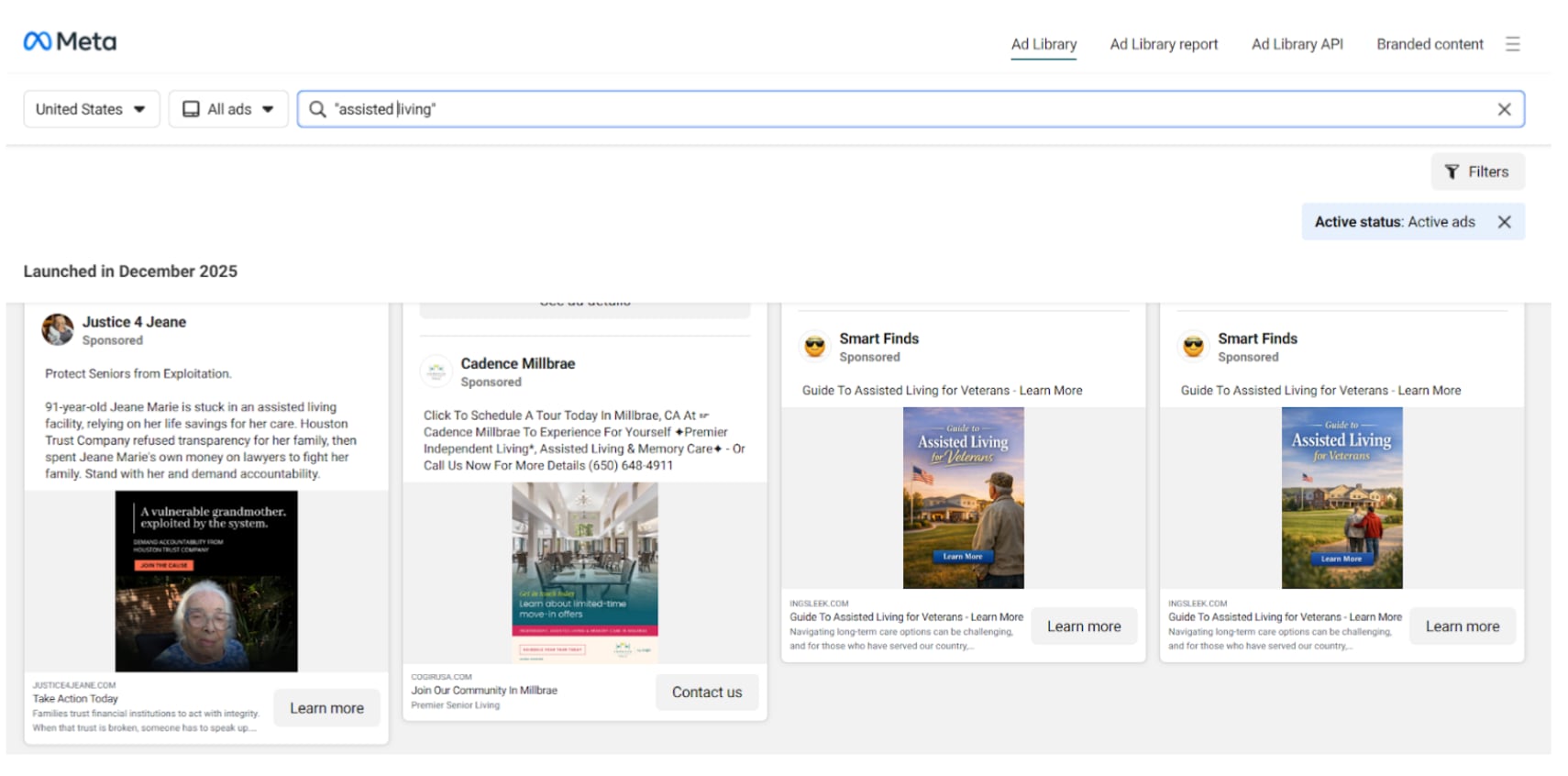
Meta Ads Library lets you research competitors' active campaigns. Search for local and national assisted living brands to find the most successful ad formats and messaging strategies.
You’ll have to keep optimizing your ads, so monitor cost-per-lead weekly, pause underperforming ads, and double down on winning combinations.